
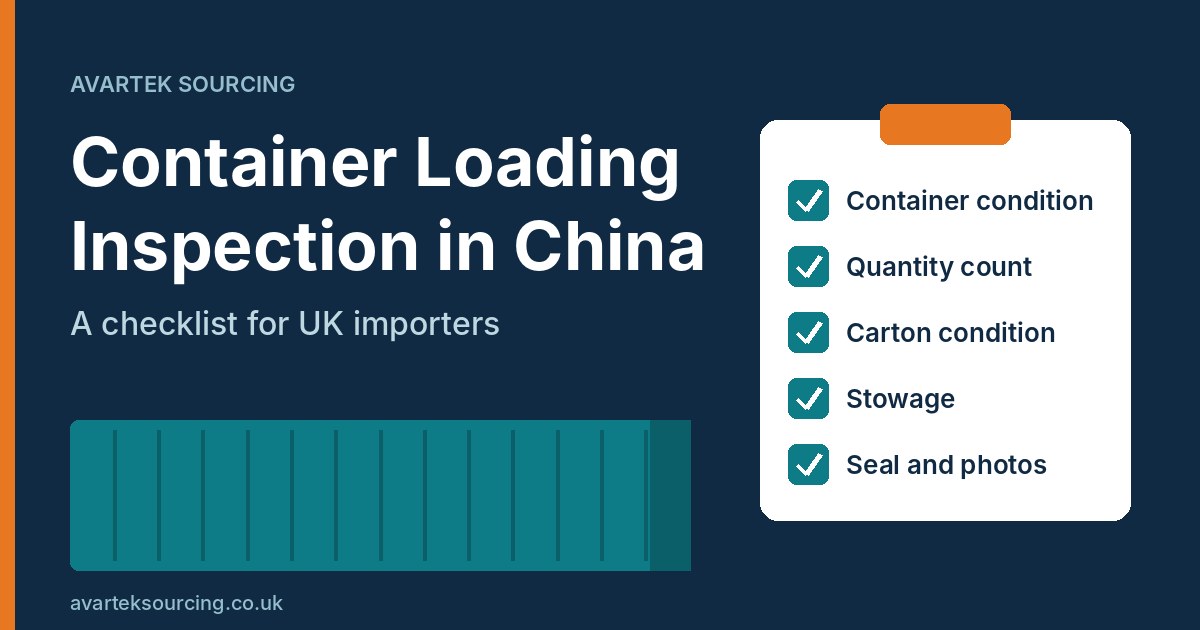
Your goods can pass every quality check and still arrive short, crushed or wet. The last chance to stop that is the day the container is loaded.
Quick answer: A container loading inspection is an independent check at the factory or warehouse while your goods are packed into the container. The inspector confirms that the right products and quantities are loaded, the cartons are in good condition, the cargo is packed safely, the container itself is sound and the doors are sealed. Anything wrong can still be fixed on the spot, before the container is at sea.
What you’ll learn
- What a container loading inspection covers, and what it does not
- A loading day checklist you can hand to your inspector
- How it differs from a pre-shipment inspection
- Six steps to arrange one, plus a worked example
- Common mistakes and answers to frequent questions
Contents: What it is | Why it matters | Loading day checklist | Loading check vs pre-shipment inspection | How to arrange one | Worked example | Common mistakes | FAQs | Conclusion
Need someone on site at the factory? Read about our inspection services or contact Avartek Sourcing with your loading date.
What is a container loading inspection?
A container loading inspection, also called a container loading check or container loading supervision, is an on-site check carried out while cartons move from the factory floor or warehouse into the container. The inspector acts as your eyes at the one moment you cannot be there.
It differs from a product inspection in China, which tests finished goods in depth. A loading check focuses on what is physically going into the container: the count, the packing, the stowage and the container itself. Avartek Sourcing lists container loading alongside supplier verification, pre-shipment inspection and factory audits in its inspection services for buyers sourcing across China.
Why a container loading check matters for UK importers
Once the doors are sealed, you cannot easily change what is inside. Three problems tend to show up after that point.
- Shortages and wrong goods. You paid for 1,200 cartons and 1,150 arrive, or the wrong variant is loaded.
- Damage in transit. TT Club, a transport insurer, found that 65% of cargo damage in containers came from poorly packed, blocked or secured cargo. That figure comes from its own claims analysis, published in 2017.
- Paperwork that does not match. Your UK customs declaration relies on the commodity code and declared value of the goods. GOV.UK tells importers to keep their commercial invoices and to report any underpaid duty or VAT to HMRC. If the packing list says one thing and the container holds another, you carry the clean-up.
Check your Incoterms before you book anything, because they decide who arranges loading and where risk passes. Our guide to Incoterms for UK importers explains the common terms. If you import from China to the UK regularly, a loading check adds a control at the one step you do not otherwise see.
Loading day checklist: what the inspector checks
Use this table as your brief. It follows the pre-packing and packing guidance in the CTU Code quick guide, which summarises the IMO/ILO/UNECE Code of Practice for packing cargo transport units.
| # | Area | What to check | Why it matters |
|---|---|---|---|
| 1 | Container condition | Damage, holes, rust, water trails, residue, debris, odours, valid CSC safety plate | Pre-existing damage and contamination can harm cargo |
| 2 | Goods and quantity | Carton count against the PO and packing list; correct SKUs and variants | Catches shortages and mix-ups |
| 3 | Carton condition | No crushed, torn or wet cartons; shipping marks readable and correct | Spots damage before the cargo travels |
| 4 | Random carton check | A few cartons opened to confirm product, labels and inner packing | Spot check, not a quality test |
| 5 | Stowage and securing | Heavy cargo low, weight spread evenly, gaps filled with dunnage or blocking | Stops cargo shifting at sea and on the road |
| 6 | Wood packaging | Pallets and crates meet ISPM 15 and carry the mark | The mark shows the wood was treated to the standard |
| 7 | Weight | Verified gross mass confirmed for sea freight | Shippers must provide it before loading |
| 8 | Seal and photos | ISO 17712 seal fitted, seal number recorded, photos of empty, part-loaded and sealed container | Proof of what left the factory |
For stowage, the CTU guide says that in a tight stow the gaps should not exceed 15 cm in any direction, and larger gaps should be filled. It also advises against using the container walls and doors to support blocking and bracing.
Container loading inspection vs pre-shipment inspection
The two checks answer different questions, and many buyers use both on a first order.
| Container loading inspection | Pre-shipment inspection | |
|---|---|---|
| Main question | Is the right cargo loaded, in the right quantity, and packed safely? | Do the finished goods meet the specification and quality standard? |
| When | While the container is being loaded | Once production is finished, before loading |
| Sampling | Cartons for count and a light spot check | A statistical sample of finished goods, often using AQL tables |
| Strongest at | Quantity, packing, container condition, sealing | Defects, function, measurements, labelling |
| Best for | Repeat orders from proven suppliers, fragile or high-value freight | New suppliers, new products, first orders |
A loading check is one layer of a China quality inspection plan, not a substitute for checking product quality. For a wider view, read our guide to quality control in China. If you have not yet checked the factory itself, see supplier verification vs factory audit first.
Planning a shipment from China? Tell us the loading date, port and goods through our quote and contact page, and we can discuss the right level of checking for your order.
How to arrange a container loading inspection
Step 1: Confirm the loading date and place
Ask your supplier for the loading date, the loading address and the container booking as early as you can. Dates move, so ask for updates as soon as anything changes.
Step 2: Send the inspector your documents
Send the purchase order, the packing list, a draft commercial invoice, carton mark details, photos of the approved sample and any labelling requirements. The more precise the brief, the fewer judgement calls on the day.
Step 3: Agree what counts as a fail
Decide in advance what happens if quantities do not match, cartons are wet or crushed, or a wrong variant turns up. Name one person who can approve a decision on the day.
Step 4: Stay reachable on loading day
If the inspector finds a problem, the container should not close until you have decided what to do. Be ready to approve a re-pack, a short shipment or a hold.
Step 5: Review the report before the container leaves
Look at the container photos, the carton count, the seal number and any deviations. If a balance payment is due before shipment, check the report first.
Step 6: Match the documents
Compare the seal number and quantities on the report with the packing list, invoice and bill of lading before you or your agent file the customs declaration. Our shipping from China to the UK guide covers what happens next.
Worked example (illustrative numbers only)
This example is made up to show the method. It does not describe a real client.
A UK seller orders 1,200 cartons of a homeware product, with 24 units in each carton at a unit price of £3.10. On loading day the inspector counts 1,150 cartons ready. The supplier suggests loading them and sending the rest later, without changing the paperwork.
- Shortfall: 1,200 minus 1,150 = 50 cartons, or 4.2% of the order
- Value of the shortfall: 50 cartons x 24 units x £3.10 = £3,720
With the report in hand, the buyer can wait for the remaining cartons, or ship 1,150 and have the invoice and packing list corrected before customs paperwork is prepared. Without it, the documents would still say 1,200 and the shortage would only surface at the warehouse.
Common mistakes to avoid
- Booking too late. An inspector cannot attend a loading that has already happened. Book as soon as the date is confirmed.
- Relying on the supplier’s own photos. They show what the supplier chose to photograph.
- Skipping the documents. Without the packing list and carton marks, the inspector cannot check the count properly.
- Ignoring the empty container. Check it before any cargo goes in, as damage or water trails are easier to deal with at that point.
- Treating it as a quality inspection. A loading check is a light spot check. Use a pre-shipment inspection for defects.
- Having nobody to decide. Problems found on the day need a quick answer from you.
FAQs
How far ahead should I book a container loading inspection?
Book as soon as your supplier confirms the loading date. Ask your inspection provider about lead times, as they depend on location and schedule.
Does the inspector stay for the whole loading?
It depends on the scope you agree. Some checks cover the full loading, others count cartons and check the container at key points. Agree the scope in writing.
Do I need one for every shipment?
Not always. It is most useful with a new supplier, fragile or high-value goods, mixed-SKU orders, or when past shipments arrived short or damaged.
What is a verified gross mass (VGM)?
It is the confirmed total weight of a packed container. The CTU Code quick guide notes that packers must verify gross mass and provide the documentation for sea transport.
Does a container loading inspection check product quality?
Only lightly. It confirms that the right goods are loaded and packed well. For defects, function and measurements, use a pre-shipment inspection.
Conclusion
A container loading inspection gives you proof of what left the factory, in what condition and in what quantity, while you can still change it. It is not a replacement for product inspection, but it covers the one step most importers never see.
Ready to protect your next shipment? Explore our inspection services or contact Avartek Sourcing with your loading date and goods.
This article gives general information only. Check your own contracts, Incoterms and customs requirements before you ship.