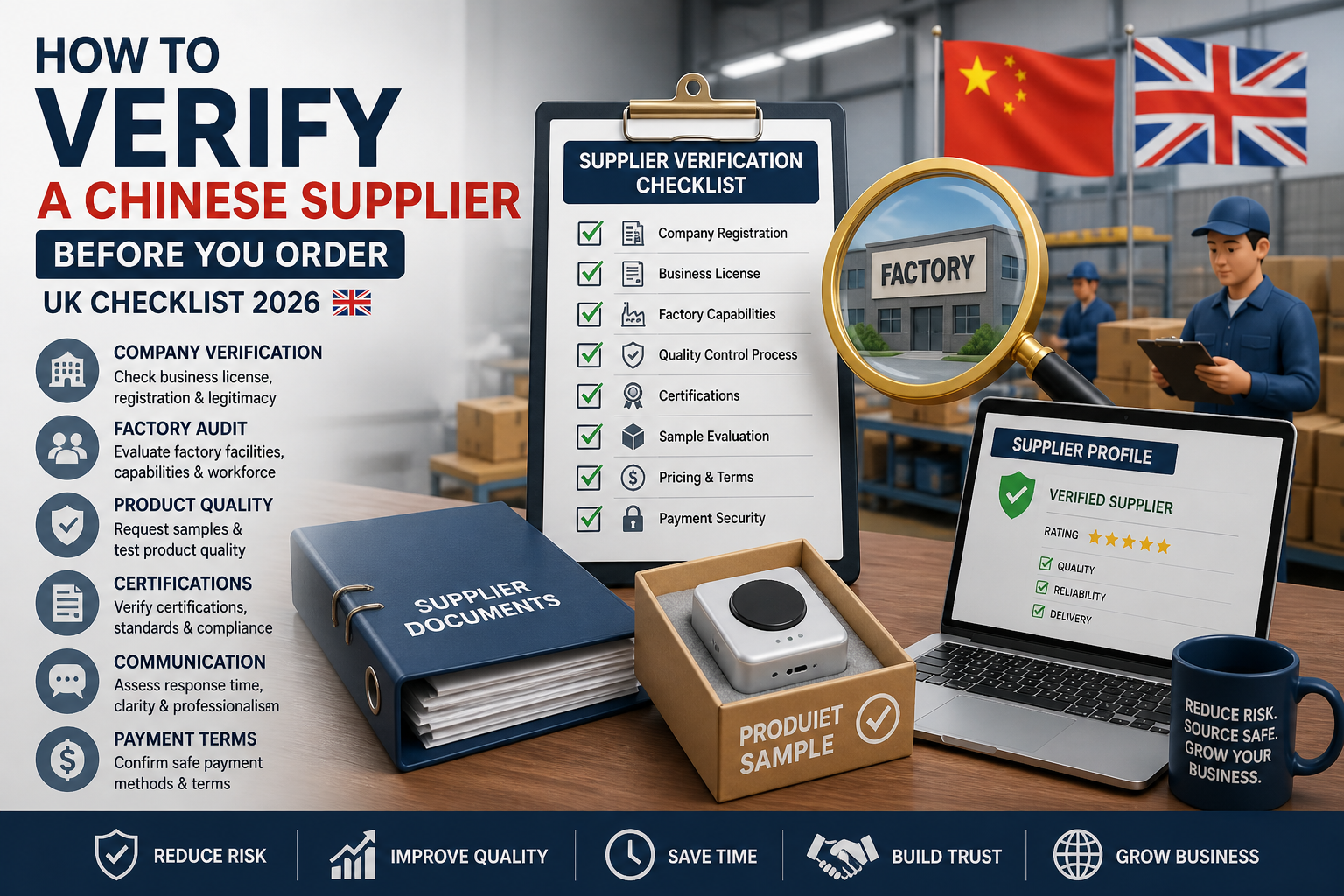
How to Verify a Chinese Supplier Before You Order (UK Checklist 2026)
One of the biggest risks when importing from China is choosing the wrong supplier. On the surface, many suppliers look professional—polished websites, fast responses, and competitive pricing—but not all are capable of delivering consistent quality.
If you don’t properly verify a Chinese supplier, you risk receiving defective goods, delayed shipments, or in the worst case, losing your payment entirely.
This guide provides a practical, step-by-step verification checklist UK businesses can use before placing any order.
Why supplier verification is critical
Supplier verification is not just about avoiding scams—it’s about ensuring your business can rely on consistent production, quality standards, and delivery timelines.
Many sourcing failures happen because businesses:
- Choose suppliers based on price
- Rely only on online profiles
- Skip due diligence to save time
A structured verification process significantly reduces these risks.
Step 1: Check company registration and legitimacy
Start by confirming that the supplier is a legally registered business.
Key checks include:
- Business licence
- Company name consistency
- Years of operation
A legitimate company should have clear documentation and no hesitation in sharing it.
Step 2: Evaluate production capability
Not all suppliers are manufacturers—some are trading companies.
Ask:
- Do they own a factory?
- What is their production capacity?
- Do they specialise in your product type?
Matching supplier capability with your product requirements is essential.
Step 3: Review product experience
Suppliers with experience in your product category are far more reliable.
Look for:
- Previous similar products
- Existing export clients
- Technical knowledge
Step 4: Assess communication quality
Communication is one of the most overlooked factors in supplier selection.
Pay attention to:
- Response time
- Clarity of answers
- Willingness to explain details
Poor communication early on usually leads to bigger issues later.
Step 5: Request samples
Samples are essential for verifying product quality before production.
Evaluate:
- Material quality
- Workmanship
- Consistency
Never skip this step.
Step 6: Conduct factory audits (if possible)
A factory audit provides deeper insight into supplier operations.
This includes:
- Production facilities
- Workforce size
- Quality control processes
Step 7: Confirm quality control processes
Ask suppliers how they manage quality.
Look for:
- Inspection procedures
- Testing standards
- Defect handling
Without proper QC, quality issues are almost guaranteed.
Step 8: Verify payment terms
Be cautious with payment structures.
- Avoid 100% upfront payments
- Use staged payments where possible
- Confirm bank account details match company name
Red flags to watch out for
- Unrealistically low prices
- Inconsistent company details
- Slow or vague communication
- No quality control process
How Avartek Sourcing helps verify suppliers
Avartek Sourcing conducts structured supplier verification, ensuring UK businesses work only with reliable, capable manufacturers.
We manage verification, sampling, and quality control, reducing risk across the entire sourcing process.