Supplier Vetting in China: How UK Importers Verify Factories and Avoid Scams in 2026
Finding a supplier is easy. Finding a supplier you can trust with your money, your lead times and your brand reputation is the hard part. In 2026, UK importers face a crowded supplier marketplace, more convincing intermediaries, and higher expectations for consistent quality. That’s why supplier vetting China is one of the most important steps in the sourcing process.
This guide explains how professional buyers verify Chinese factories, what red flags to watch for, and how to build a repeatable vetting system that protects every order. It also connects with the March sourcing cluster, including Blog 1 (agents), Blog 2 (process), Blog 3 (models), Blog 4 (risk), Blog 5 (scaling), Blog 6 (QC), and Blog 8 (procurement).
Why supplier vetting matters more in 2026
Supplier problems usually don’t start with a dramatic failure. They start small: unclear answers, shifting terms, sample-to-production differences, or sudden delays. Over time, those small issues become expensive—especially once you have deposits paid, marketing launched, and customer expectations set.
Effective supplier vetting reduces:
- Fraud and misrepresentation: middlemen posing as factories
- Quality failures: weak internal QC systems and inconsistent processes
- Capacity risk: suppliers that cannot meet your production timelines
- Compliance risk: suppliers unfamiliar with UK market expectations
- Communication risk: unclear ownership, vague accountability, slow responses
If you’re new to professional sourcing, start with Blog 1 for a complete overview of what a China sourcing agent does.
Factory vs trading company: verify what you’re dealing with
Before you assess quality or price, confirm what the supplier actually is. A trading company is not automatically “bad,” but it changes pricing transparency, accountability and your ability to control production.
For a clear comparison, read Blog 3: China Sourcing Company vs Trading Company.
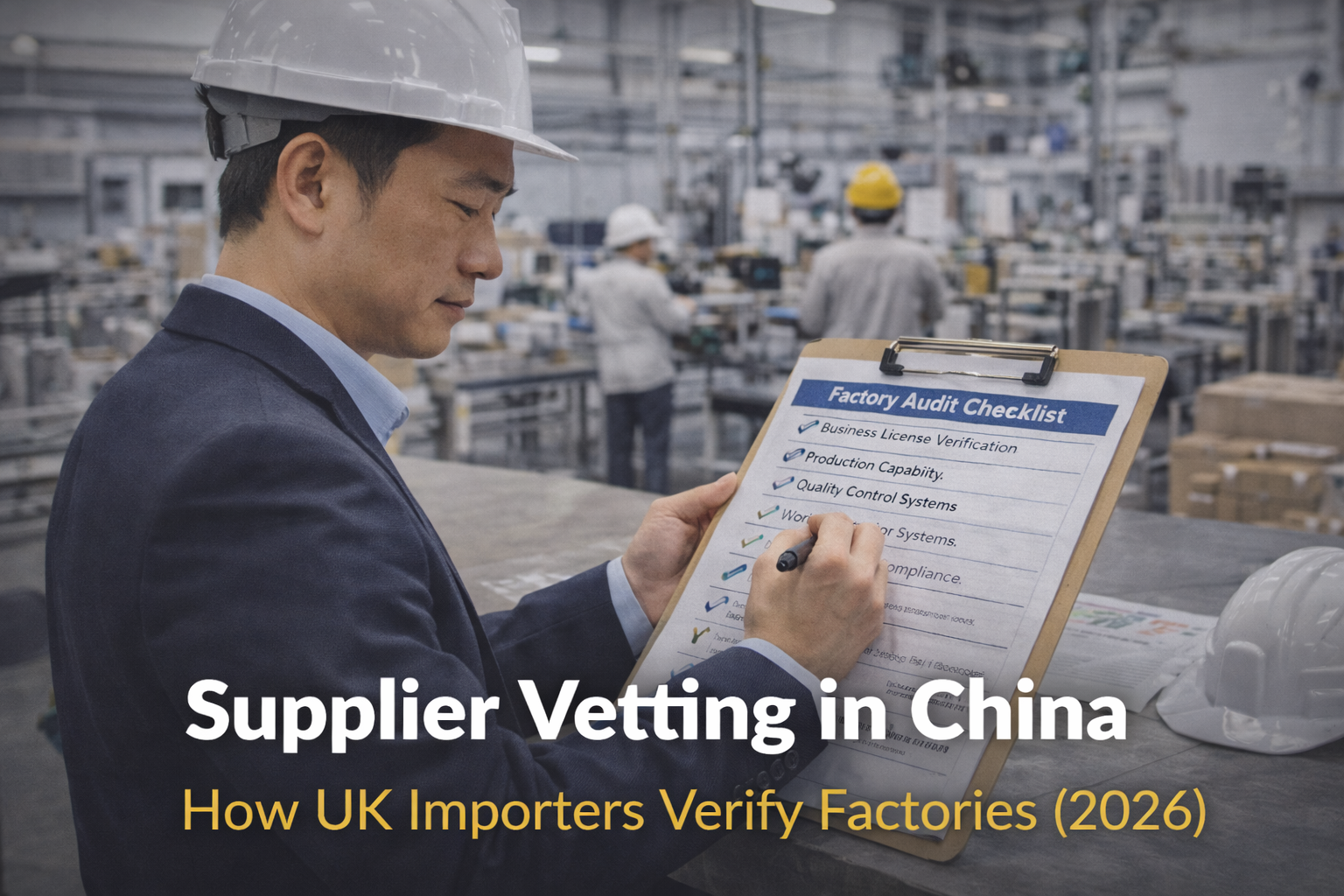
The supplier vetting checklist (professional standard)
1) Business identity and documentation
Start with foundational checks. A professional vetting workflow typically validates:
- Company registration details and legal name
- Business licence documentation consistency
- Bank account details matching the legal entity
- Export capability and experience signals (where relevant)
Mismatch between documents, email domains, company names, and payment instructions is a common early warning sign.
2) Product and category capability
Many suppliers can produce “something similar.” That doesn’t mean they can hit your finish standards, tolerances, packaging requirements or volume needs. Capability checks should confirm:
- Relevant equipment and production lines
- Past production examples that match your product complexity
- Capacity for your required monthly volume
- Lead-time realism (not just what they promise to win the order)
3) Quality control systems and accountability
Ask how quality is managed internally. Strong suppliers have clear QC checkpoints, documented processes, and a willingness to address defects. This should align with your inspection approach. For inspection timing and types, see Blog 6.
4) Sampling discipline (sample-to-production consistency)
Vetting does not stop when you receive a sample. Many issues happen because the sample was produced with extra care—or different materials—than mass production. Use staged sampling and lock the spec before deposit payments. This is covered step-by-step in Blog 2.
5) Communication quality and responsiveness
How a supplier communicates during the “sales” stage is usually their best behaviour. If responses are vague now, they will be worse when production is under pressure. Vet for:
- Clear answers, not evasive language
- Fast turnaround on clarifications
- Willingness to confirm details in writing
- Stable points of contact
6) Factory audit (when it’s worth it)
A factory audit is most valuable when:
- Your order value is high enough that failure is painful
- You are developing a branded product
- You plan repeat orders and long-term supply
- Quality issues would damage your reputation
If you’re scaling a brand, this is even more critical—see Blog 5.
Red flags UK importers should take seriously
Red flags do not always mean “walk away,” but they should trigger deeper verification:
- Pressure to pay quickly or bypass normal steps
- Refusal to provide consistent business documentation
- Bank details that do not match the legal company name
- Overly broad product range that looks like a reseller
- Unrealistic prices compared to market norms
- “We can do anything” claims without proof
If you want a broader risk framework beyond vetting, read Blog 4 and Blog 8.
How supplier vetting fits into a complete sourcing system
Supplier vetting is one stage of a controlled process. The best results happen when vetting connects directly to sampling, production milestones and inspections. That full workflow is outlined in Blog 2.
If you are deciding whether you need structured support, Blog 1 explains what a sourcing agent does, while Blog 8 explains broader procurement support.
How Avartek Sourcing supports supplier vetting in China
Avartek Sourcing supports UK importers with supplier verification, factory capability screening, sampling management and quality control checkpoints—so you can scale with fewer surprises.
Next step: If you have a shortlist of suppliers and want professional verification before sending deposits, contact Avartek via /contact/.