
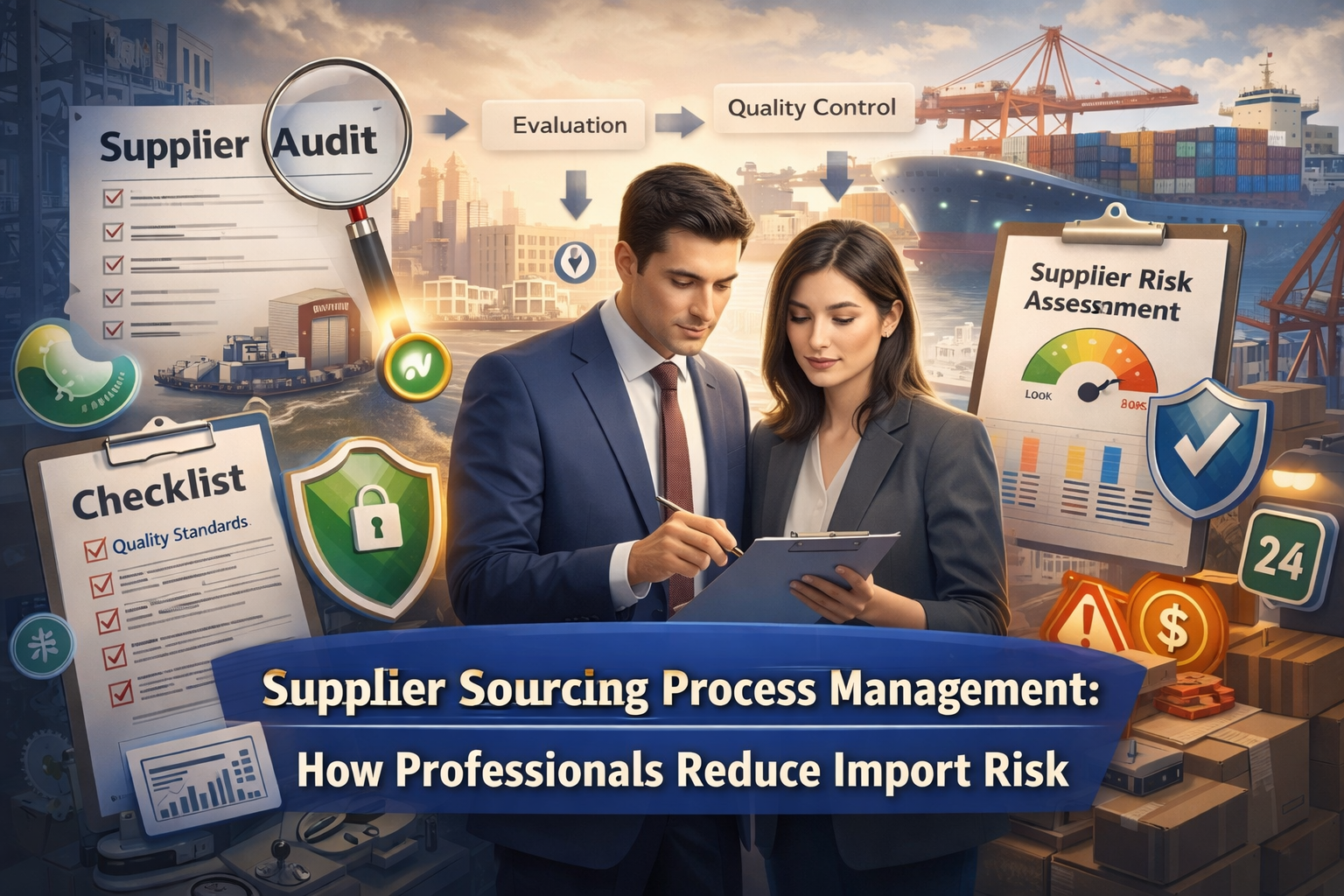
Supplier Sourcing Process Management: How UK Businesses Reduce Import Risk
Many UK businesses believe that sourcing from China is risky by default. In reality, the risk usually comes from
poor process, not from China itself.
Professional importers don’t rely on luck or supplier promises. They rely on
supplier sourcing process management — a structured approach that controls cost, quality, timelines,
and accountability from the first enquiry to delivery in the UK.
What is supplier sourcing process management?
Supplier sourcing process management is the end-to-end system used to control how suppliers are selected, managed,
and evaluated throughout the sourcing lifecycle.
It goes far beyond “finding a factory”. It covers:
- How suppliers are identified and shortlisted
- How quotes are compared and negotiated
- How samples are approved and specifications locked
- How production is monitored
- How quality is measured and enforced
- How shipments are approved before export
Without a defined process, sourcing decisions become reactive, inconsistent, and expensive.
Why most sourcing problems happen after the supplier is chosen
Many UK importers spend most of their time searching for suppliers and very little time managing them.
This is where things usually go wrong.
Common failures include:
- Samples that don’t match mass production
- Unclear quality standards leading to disputes
- Late production with no escalation path
- Packaging mistakes that cause damage or non-compliance
- Goods shipped without inspection
A sourcing process exists to prevent these issues before they become irreversible.
The 7-stage supplier sourcing process used by professionals
1. Product brief and specification control
Everything starts with documentation. This includes materials, dimensions, tolerances, performance requirements,
packaging, labelling, and UK compliance needs.
If it is not written down, it cannot be enforced.
2. Supplier identification
Suppliers are shortlisted based on capability, experience, and suitability — not just price.
A professional sourcing partner will usually evaluate multiple factories before moving forward.
3. Supplier verification
Verification includes checking business legitimacy, export experience, responsiveness, and production capability.
This step alone eliminates many high-risk suppliers.
4. RFQ comparison and negotiation
Quotes must be compared on a like-for-like basis, including tooling, packaging, lead times, incoterms,
and payment terms. A low unit price can hide expensive risks.
5. Sampling and approval
Samples are used to confirm materials, construction, performance, and finish.
Any changes must be agreed and documented before mass production begins.
6. Production monitoring
Production milestones are tracked so issues can be corrected early.
Problems caught late are always more expensive to fix.
7. Quality control and shipment approval
Pre-shipment inspections confirm products meet agreed standards before they leave the factory.
Once goods are shipped, leverage is lost.
How procurement services companies reduce risk
A procurement services company or China sourcing partner applies this process consistently,
even as volumes and supplier numbers increase.
This allows UK businesses to scale without increasing risk at the same rate.
How Avartek Sourcing applies sourcing process management
Avartek Sourcing uses structured supplier sourcing process management to help UK businesses import from China
with confidence.
We manage supplier verification, quotations, sampling, production oversight, and
China sourcing and quality control services before shipment.