Finding a Chinese supplier is relatively easy. Finding a supplier you can trust with a large order is much more important.
A supplier may offer an attractive price, impressive product photos and a professional-looking website, but these things do not necessarily confirm that the business is genuine, that it owns a factory, or that it can consistently produce your product to the required standard.
For UK businesses importing from China, proper supplier verification can help reduce the risk of payment problems, poor-quality goods, production delays and compliance issues. HMRC also advises businesses to carry out appropriate due diligence and keep enough information and documentation to support their transactions.
This guide explains how to verify a Chinese supplier before committing to a bulk order.
Why Chinese Supplier Verification Matters
A bulk order involves much more risk than purchasing a few samples.
You may need to pay a deposit before production starts, commit to a minimum order quantity (MOQ), arrange shipping and then sell the products in the UK.
If something goes wrong, recovering your money or replacing thousands of units can be difficult.
Common problems can include:
- The supplier is not the manufacturer they claim to be
- The company details do not match the contract
- The supplier uses another factory for production
- Product specifications change during production
- Quality is lower than the approved sample
- Required certifications are missing or unsuitable
- The supplier requests payment to an unrelated third party
- Production capacity is lower than promised
This is why supplier verification should happen before placing a significant order, not after a problem occurs.
1. Check the Supplier’s Legal Business Details
Start by asking the supplier for its official company information.
Do not rely only on the English company name shown on Alibaba, a website or an email signature.
Ask for:
- Full registered Chinese company name
- Business licence
- Unified Social Credit Code
- Registered address
- Legal representative
- Business scope
- Company contact details
The legal entity shown on your quotation, purchase agreement and payment documentation should match the business you have verified.
This is particularly important because the supplier’s English trading name may not be the same as its registered Chinese company name.
A supplier that is unwilling to provide basic company information should be treated as a warning sign.
2. Confirm That the Company Actually Exists
Once you have the company’s registered information, check whether the details are consistent.
Look for differences between:
- Business licence
- Quotation
- Company website
- Bank information
- Purchase contract
- Factory address
- Contact details
You want to establish that these documents and channels refer to the same business entity.
Do not assume that a professional website automatically proves that the company is a genuine manufacturer.
3. Find Out Whether You Are Dealing With a Factory or Trading Company
Not every supplier that describes itself as a manufacturer actually owns a manufacturing facility.
A trading company is not automatically a bad supplier. In some situations, a trading company may provide useful sourcing and export support.
The important point is to understand who you are actually buying from.
Ask:
- Do you own the factory?
- Where is production carried out?
- What products do you manufacture?
- How many production lines do you have?
- How many workers are employed?
- What is your monthly production capacity?
- Do you use subcontractors?
- Can you provide a factory address?
If a supplier claims to be a factory but cannot clearly explain its manufacturing operation, investigate further before placing a bulk order.
4. Verify the Factory Address
The supplier’s registered office and manufacturing facility may not be the same location.
This is an important distinction.
Ask the supplier for the actual production facility address and determine whether it matches the factory information provided during your discussions.
A factory verification can go beyond checking paperwork by examining the physical site, production equipment, workforce, manufacturing processes and quality-control systems.
This is where a Factory Audit can provide additional information that basic document checks cannot.
5. Check Their Manufacturing Capability
A supplier may be able to produce samples but struggle with a large production run.
Before placing a bulk order, ask questions about production capacity.
For example:
- What is the normal MOQ?
- What is the monthly production capacity?
- How long does production take?
- What machinery is used?
- How many production lines are available?
- Is production carried out in-house?
- What happens if demand increases?
- Do they use subcontractors?
Your objective is not simply to find the supplier offering the lowest price.
You need to establish whether the supplier can reliably produce your required quantity to the agreed specification.
6. Request Samples Before Ordering in Bulk
Never rely entirely on product photographs or descriptions.
Request a sample and compare it against your requirements.
Check:
- Materials
- Dimensions
- Weight
- Colour
- Finish
- Functionality
- Components
- Packaging
- Labelling
- Accessories
- Overall build quality
If possible, create a written product specification that both sides agree to.
The approved sample should not be treated as the only quality reference. Your final purchase agreement should clearly define the specifications that the bulk production must meet.
7. Check Quality Control Procedures
Ask the supplier how quality is controlled during production.
Questions can include:
- Who performs quality inspections?
- When are inspections carried out?
- Are incoming materials checked?
- Are finished products inspected?
- How are defective products handled?
- Are inspection records maintained?
- What happens if products fail the agreed requirements?
A supplier saying “we have quality control” is not enough.
You need to understand what that process actually involves.
For larger orders, independent product inspections can provide another layer of control.
During Production Inspection
A During Production Inspection (DPI) can be useful when you want to identify problems while production is still underway.
Finding an issue during production gives you more opportunity to discuss corrective action before the entire order is completed.
Pre-Shipment Inspection
A Pre-Shipment Inspection (PSI) takes place when production is sufficiently complete to assess the finished goods before shipment.
This can help check whether the goods meet the agreed specifications before they leave China.
8. Verify Certifications and Product Compliance
This step is particularly important for UK importers.
The compliance requirements depend on the product you are importing. Some products may require specific documentation, testing, labelling or conformity requirements.
For example, UK government guidance states that businesses placing products on the Great Britain market need to follow the requirements applicable to their particular product. Current guidance also covers the use of UKCA and CE marking regimes for relevant products.
Do not simply accept a certificate because the supplier sends you a PDF.
Check:
- Which company is named on the certificate
- Whether the certificate applies to your exact product
- Whether the model number matches
- Whether the issuing organisation is appropriate
- Whether the document is current
- Whether additional testing is required
The UK government also notes that businesses importing or selling consumer products have responsibilities relating to product safety and traceability.
9. Check the Payment Details Carefully
Payment fraud can create serious problems during international sourcing.
Before sending a deposit, compare the payment details with the verified company information.
Pay particular attention if a supplier suddenly asks you to send money to:
- A different company
- A personal bank account
- An unrelated third party
- A new offshore account
- An account that does not match the contracted supplier
HMRC identifies requests for third-party or offshore payments and cash-only payments among characteristics that can warrant suspicion during supply-chain due diligence.
If payment information changes unexpectedly, verify the change through an independent communication channel before transferring funds.
10. Look for Red Flags
No single warning sign automatically means that a supplier is fraudulent or unsuitable.
However, several warning signs together deserve further investigation.
Watch for:
- Unusually low prices
- Pressure to pay immediately
- Refusal to provide company documents
- Inconsistent company information
- Unclear factory location
- Reluctance to provide samples
- Certificates that do not match the product
- Frequent changes to bank details
- Poor communication about specifications
- Promises that seem unrealistic
- Inability to explain production capacity
A low quotation should not automatically be treated as a bargain.
The cheapest supplier can become the most expensive option if the order arrives late, fails inspection or does not match the agreed specification.
When Should You Arrange a Factory Audit?
Basic supplier verification can help establish who the supplier is and whether its claims appear consistent.
A Factory Audit goes further by examining the supplier’s actual manufacturing operation.
Depending on the scope, an audit can assess areas such as:
- Factory facilities
- Production equipment
- Manufacturing capacity
- Quality-control procedures
- Workforce
- Production processes
- Warehouse facilities
- Management systems
For a significant first order, a factory audit can provide useful information before you commit substantial funds to production.
Why Supplier Verification Is Not the End of the Process
Even after verifying a supplier, quality control should continue throughout the order.
A supplier can be genuine and still produce goods that do not meet your requirements.
For this reason, businesses may use different inspection stages depending on the order and product:
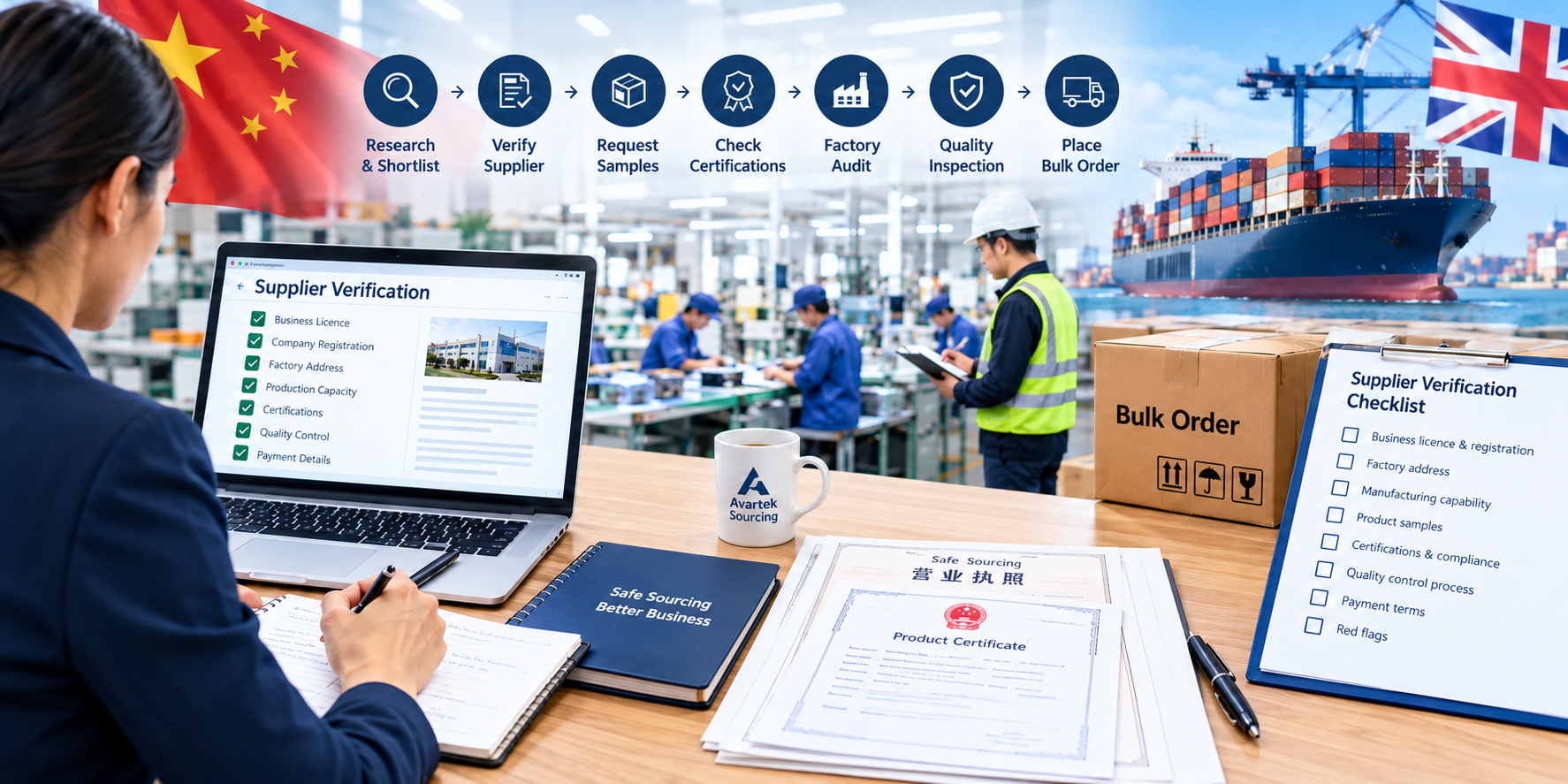
Supplier Verification → Factory Audit → During Production Inspection → Pre-Shipment Inspection → Container Loading Supervision
Container Loading Supervision (CLS) can provide an additional check during the loading process, helping confirm that the agreed goods and quantities are loaded correctly.
The right inspection approach depends on the product, order value, risk level and sourcing requirements.
Chinese Supplier Verification Checklist
Before placing a bulk order, ask yourself:
| Check | Completed? |
| Verified the supplier’s legal company name | ☐ |
| Checked the business licence | ☐ |
| Confirmed the registered company details | ☐ |
| Confirmed factory or production location | ☐ |
| Established whether it is a factory or trading company | ☐ |
| Checked manufacturing capacity | ☐ |
| Received and assessed product samples | ☐ |
| Confirmed product specifications in writing | ☐ |
| Checked relevant certifications | ☐ |
| Reviewed quality-control procedures | ☐ |
| Verified payment details | ☐ |
| Considered a factory audit | ☐ |
| Considered product inspection | ☐ |
Completing these checks does not remove every sourcing risk, but it can help you make a more informed purchasing decision.
How Avartek Sourcing Can Help
Verifying an overseas supplier can take time, particularly when you need to check company information, factory capability, product requirements and quality processes before placing a significant order.
Avartek Sourcing helps UK businesses manage sourcing and supplier verification in China.
Our services can include Supplier Verification, Factory Audit, During Production Inspection (DPI), Pre-Shipment Inspection (PSI), and Container Loading Supervision (CLS).
Using the appropriate checks at the right stage can give buyers greater visibility before, during and after production.
Conclusion
Choosing a Chinese supplier should not be based on price alone.
Before placing a bulk order, verify the company’s identity, understand whether you are dealing with a factory or trading company, confirm its production capability, assess samples, check relevant compliance requirements and carefully review payment details.
For larger or higher-risk orders, consider adding a Factory Audit and independent product inspections to your sourcing process.
The goal is simple: know who you are buying from, know what they can produce, and confirm that the finished goods meet the requirements you agreed before they reach the UK.
FAQs
How do I verify a Chinese supplier?
Start by checking the supplier’s registered company information, business licence, company name, business scope, address and manufacturing capability. You can then verify samples, certifications, payment details and, where appropriate, arrange a factory audit.
How can I tell if a Chinese supplier is a real factory?
Ask for the actual production facility address, manufacturing information, equipment details and production capacity. A physical factory audit can provide further evidence of the supplier’s facilities and operations.
Should I use a Chinese supplier or trading company?
It depends on your requirements. A trading company may provide sourcing and export services, while a manufacturer may offer more direct control over production. The important thing is to understand who you are contracting with and where your products will actually be produced.
Should I inspect products before shipping from China?
For many bulk orders, a pre-shipment inspection can be useful for checking whether finished goods meet the agreed requirements before they are shipped.
What should I check before paying a Chinese supplier?
Check the supplier’s legal identity, contract details, quotation, product specifications and bank/payment information. Any unexpected request to change the payment recipient should be independently verified before payment.
Do UK importers need to check product compliance?
Yes. UK importers need to understand the rules applicable to the products they import and sell. Requirements can include product safety, marking, labelling, documentation and conformity requirements depending on the product.