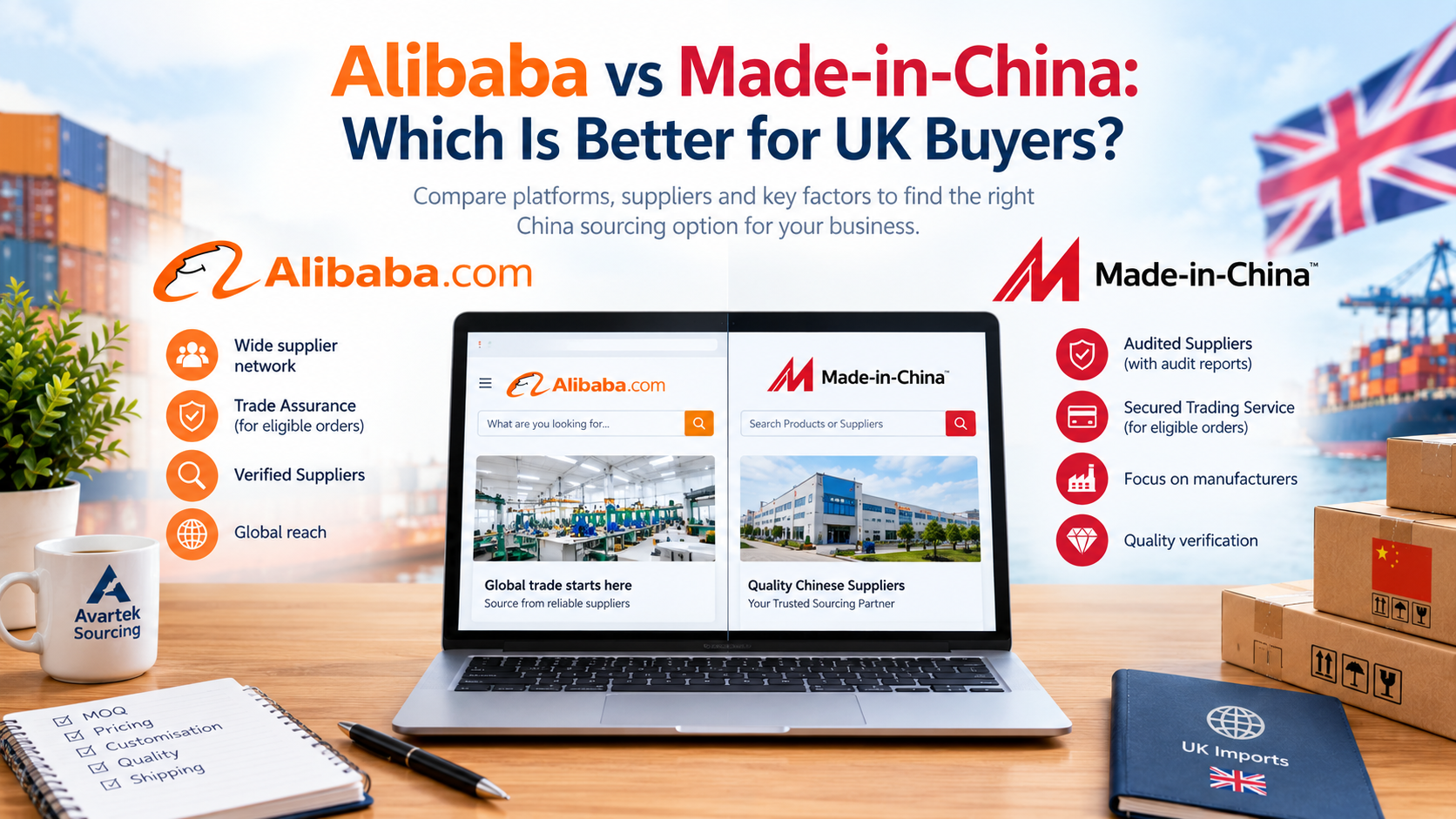
Choosing the right platform can make a big difference when sourcing products from China. Two of the most established options are Alibaba and Made-in-China.com.
Both platforms connect international buyers with Chinese suppliers, manufacturers and trading companies. However, the supplier selection process, verification features, buyer protection and sourcing experience can differ.
So, which is better for a UK business?
The answer depends on what you are buying, your order size, how much customisation you need and how confident you are with supplier verification.
This guide compares Alibaba vs Made-in-China for UK buyers and explains what to consider before placing an order.
Alibaba vs Made-in-China: Quick Comparison
| Factor | Alibaba | Made-in-China |
| Main use | Global B2B sourcing | Global B2B sourcing |
| Product range | Very broad | Broad |
| Chinese suppliers | Yes | Yes |
| Custom manufacturing | Strong | Strong |
| Supplier verification | Verified Supplier and other supplier information | Audited Supplier and audit reports |
| Buyer protection | Trade Assurance for eligible orders | Secured Trading Service for eligible orders |
| Samples | Available from many suppliers | Available from many suppliers |
| Bulk orders | Yes | Yes |
| Private labelling | Available from suitable suppliers | Available from suitable suppliers |
| UK buyers | Well suited | Well suited |
| Best for | Buyers wanting a large supplier marketplace and integrated transaction tools | Buyers who value supplier audit information and structured supplier discovery |
The important point is that neither platform automatically guarantees that a supplier is suitable for your business. You still need to check the supplier, product specifications, samples, pricing and quality before placing a large order.
What Is Alibaba?
Alibaba is one of the best-known B2B sourcing platforms for businesses buying products from manufacturers and suppliers, particularly when ordering in commercial quantities.
UK businesses can use Alibaba to search for products, compare suppliers, request quotations and communicate directly with potential suppliers.
Alibaba also offers Trade Assurance for eligible orders. According to Alibaba, this can provide protection relating to payment, product issues and agreed shipping terms, with dispute assistance available when the order does not meet the agreed requirements.
Alibaba also has Verified Suppliers, where supplier company profiles, production capabilities and other areas can be inspected and assessed by independent third-party organisations.
This can make Alibaba useful for businesses looking to compare a large number of suppliers before narrowing down their options.
What Is Made-in-China.com?
Made-in-China.com is another B2B platform connecting international buyers with Chinese suppliers.
It is particularly notable for its Audited Supplier system. Made-in-China says Audited Suppliers undergo on-site verification, with audit reports prepared by third-party organisations such as SGS, Bureau Veritas, TÜV Rheinland and CTI.
Buyers can use these reports to investigate areas such as production capabilities, quality management and other business information before contacting a supplier.
Made-in-China also offers Secured Trading Service (STS) for eligible transactions. The service is designed to provide payment and transaction protection, including an escrow-style payment process and dispute support.
For UK buyers who place a strong emphasis on reviewing supplier audit information, this can be an attractive feature.
Alibaba vs Made-in-China for Supplier Verification
Supplier verification should be one of the first things you consider when sourcing from China.
A professional-looking supplier profile does not necessarily mean the company is the right manufacturer for your product.
Alibaba
Alibaba’s Verified Supplier programme uses independent third-party inspection companies to assess supplier information and capabilities. Buyers can access inspection information for participating suppliers.
Made-in-China
Made-in-China’s Audited Supplier system provides buyers with third-party audit reports covering areas such as company information, production capabilities and quality control systems.
Which is better?
Both provide useful verification tools.
However, you should treat platform verification as a starting point rather than a replacement for your own due diligence.
For a significant order, you may still want to:
- Confirm the company’s legal details
- Check whether it is a manufacturer or trading company
- Review its production capabilities
- Request product samples
- Check relevant certifications
- Confirm the factory address
- Compare specifications and quotations
- Arrange an independent factory audit where appropriate
This is particularly important when ordering products that have safety, compliance or quality requirements for the UK market.
Alibaba vs Made-in-China: MOQ and Pricing
Minimum order quantities (MOQs) vary considerably between suppliers.
You may find one supplier willing to accept a relatively small trial order while another requires a much larger quantity.
Therefore, it is difficult to say that Alibaba always has lower MOQs or Made-in-China always has cheaper prices.
Instead, compare suppliers individually.
When requesting quotations, give every supplier the same information:
- Product specifications
- Materials
- Dimensions
- Colour
- Packaging requirements
- Branding requirements
- Quantity
- Target delivery location
- Required certifications
- Expected order frequency
This allows you to make a much more meaningful comparison.
And don’t automatically choose the lowest quotation.
A cheaper unit price may come with lower material quality, weaker packaging, different specifications or additional costs later.
Which Platform Is Better for Custom Products?
Both Alibaba and Made-in-China can be used to find suppliers offering customised products.
This can include:
- Private labelling
- Custom packaging
- Product modifications
- OEM manufacturing
- ODM products
- Custom colours and materials
However, the platform itself is less important than the supplier you select.
Before agreeing to a custom order, ask the supplier to confirm exactly what is included in the quotation.
For example, if you require your logo on a product, confirm:
Logo placement + printing method + packaging + artwork requirements + tooling costs + MOQ + sample approval
Ideally, approve a production sample before committing to a large order.
Alibaba vs Made-in-China: Buyer Protection
Buyer protection is another important consideration for UK businesses.
Alibaba’s Trade Assurance is designed to protect eligible transactions, with Alibaba stating that it can cover areas such as payment security, product issues and agreed shipping arrangements.
Made-in-China provides Secured Trading Service, which is intended to protect transactions through features including managed payments and dispute support.
However, don’t assume that platform protection eliminates every sourcing risk.
The safest approach is still to make sure your purchase order clearly specifies:
- Product specifications
- Quantity
- Quality requirements
- Packaging
- Delivery deadline
- Inspection requirements
- Accepted tolerances
- Payment terms
The more clearly the agreement is documented, the easier it is to identify whether an order has met the agreed requirements.
Which Is Better for UK Amazon and eBay Sellers?
For UK Amazon and eBay sellers, both platforms can be useful.
If you are starting with a relatively simple product, you may use either platform to identify several potential suppliers and request samples.
Once you find a promising supplier, don’t immediately place your full order.
A better process is:
Search → Shortlist → Verify → Request samples → Compare quotations → Confirm specifications → Inspect → Order
For larger orders, independent quality checks can become particularly valuable.
For example, an Inspection Service can help check products before they leave China, rather than discovering quality problems after the shipment reaches the UK.
Alibaba vs Made-in-China: Which Is Better for New UK Buyers?
If you’re completely new to importing from China, the most important factor isn’t necessarily whether you choose Alibaba or Made-in-China.
It’s how carefully you evaluate the supplier.
A beginner should ideally:
- Shortlist several suppliers.
- Check their business information.
- Compare quotations.
- Ask detailed questions.
- Request samples.
- Confirm product specifications in writing.
- Check relevant UK compliance requirements.
- Start with a manageable order.
- Arrange inspection where appropriate.
- Keep all important communication and agreements documented.
Using a platform makes finding suppliers easier. It does not remove the need for due diligence.
When Should You Use a China Sourcing Agent?
A sourcing platform can be a good starting point, but some UK businesses prefer additional support when dealing with Chinese suppliers.
A sourcing agent can help with activities such as:
- Finding suitable suppliers
- Comparing quotations
- Communicating with factories
- Negotiating commercial terms
- Checking samples
- Coordinating inspections
- Monitoring production
- Arranging shipping
This can be particularly useful if you are ordering customised products, working with several factories or don’t have experience managing suppliers in China.
At Avartek Sourcing, our China Sourcing Services can help UK businesses identify and work with suitable suppliers, while our Supplier Verification Services, Quality Control Services, and Inspection Services can provide additional checks before committing to a large order.
So, Alibaba or Made-in-China?
There isn’t one platform that is automatically better for every UK buyer.
Choose Alibaba if:
You want access to a large B2B marketplace, a wide range of suppliers and integrated tools such as Trade Assurance for eligible orders.
Consider Made-in-China if:
You place particular value on supplier audit information and want to use its Audited Supplier and audit-report system when evaluating Chinese suppliers.
For many UK businesses, the best approach is actually to use both platforms during supplier research.
Compare several suppliers rather than relying on the first attractive quotation you receive.
Most importantly, remember that finding a supplier is only the first part of sourcing from China. Verification, samples, clear specifications and quality inspection can have a much bigger impact on the success of your order.
Frequently Asked Questions
Is Alibaba better than Made-in-China?
Not necessarily. Both platforms provide access to Chinese suppliers. The better option depends on your product, supplier requirements, order size and preferred verification and transaction features.
Is Made-in-China safe for UK buyers?
Made-in-China provides supplier verification features and Secured Trading Service for eligible transactions. However, UK buyers should still carry out their own supplier due diligence before placing significant orders.
Can I find manufacturers on both Alibaba and Made-in-China?
Yes. Both platforms list Chinese manufacturers and other types of suppliers. You should confirm whether a particular company is the actual manufacturer or a trading company before placing an order.
Which is cheaper, Alibaba or Made-in-China?
Neither platform is consistently cheaper. Product prices depend on the supplier, specifications, quantity, materials, packaging, customisation and shipping terms.
Should I inspect products before shipping from China?
For larger or higher-risk orders, a pre-shipment inspection can be a sensible way to identify quality or quantity problems before the goods leave China.
Can a UK business use a sourcing agent with Alibaba or Made-in-China?
Yes. A sourcing agent can help you research suppliers, compare quotations, communicate with factories and coordinate quality checks, regardless of which sourcing platform was used to find the supplier.
Final Verdict
Alibaba vs Made-in-China isn’t really about finding a single winner.
Both platforms can help UK businesses find Chinese suppliers, compare products and start conversations with manufacturers.
The bigger difference comes from how you evaluate the supplier after finding them.
If you’re comparing suppliers for a serious commercial order, don’t base your decision on price or platform badges alone. Check the company, verify its capabilities, approve samples and make sure your specifications are clearly documented.
For larger orders, independent Supplier Verification, Factory Audit and Product Inspection can provide an additional layer of protection before your money and products are committed.
The best China sourcing strategy is not simply finding the cheapest supplier — it’s finding a supplier that can consistently deliver the right product, quality and quantity at the agreed cost.